Journal #4 – The Twitter, the Tweet, & Me

Standard

The Twitter, the Tweet, & Me

twitter-list

“Create some lists on Twitter related to your beat and other interests. Find some new people to follow related to your topic of focus and other interests. Start interacting with others in your area of focus. Describe what you did in your journal blog.”


So Twitter, we meet again.  Last week, after reading the Mashable Twitter GuideBook, I was feeling a bit more comfortable with the whole Tweetin’ thing.  It’s not that I don’t know how to tweet or dislike tweeting – it’s that i’m not the most comfortable with tweeting.  I often wonder – why tweet?

I mean, I get it – “live life in 140 characters or less.”  If you haven’t noticed – that’s not exactly MY motto.  In fact, I would feel rather hypocritical even pretending to use it seriously. However, I am a Political Public Relations person – I suppose I should become “twiterate” quickly.

In order to move forward in becoming “twiterate,” there is this thing called organization through list-making that I must attend to.  Great – organization – another term that typically escapes me – especially in the social media world.  I never got into “lists” on Facebook and finding bookmark on my browsers was like searching for a needle in a haystack until recently.  I’m good at organizing and work stuff is always well-organized but my personal life is always lacking in organization.  I have specific places for all my clothes and expensive hangers and drawers on which to put them, but somehow yesterday’s clothes (last week’s clothes) are usually found tossed over a chair and several pairs of shoes are lining the hallways and rooms of my house.  Maybe the word I am in need of here is none other than motivation…or time.  Yes…time.  That’s probably the one.

But…I  figured that not every person who sings the praises of Twitter Lists could be wrong and maybe, just maybe it would make Twitter more Robin-friendly – especially for my new TN Liberty blog.  This way I could easily keep track of each section of Tennessee.  Hopefully, this list-making would keep me from overlooking any current events and grievances, state legislation, and news specifically relevant to the state of Tennessee and the issues of the Liberty Movement.

So in keeping with my new found organizational spirit, I started making those pesky lists.


twitter_bird_follow_me twitter list


The next step was to finally download TweetDeck – a dashboard/app type device that supposedly makes Twitter more organizable and easier to use.  Done.  If you’re interested in using TweetDeck, Google Chrome browser has a nifty free app/extension that you can download, by clicking here.

Then, as I began to rifle through the 840 people that I’m currently following, I decided that one of my future steps would be to give the ol’ Twitter a good spring cleaning.  Not today – but someday soon.  Before reading the Mashable Twitter GuideBook I really didn’t understand that Twitter was “different’ than other social mediums in terms of the following/follower relationship.  I felt that because some random nutjob followed me that I owed it to him/her/it to follow back.  Does anyone want to take a guess as to what that left me with?  Yep – a whole lot of weirdos, nutjobs, and people I am tired of hearing from every 2 minutes.  But, for now, the  nutjobs would remain.

Once I had TweetDeck up and running and started to use the +Create lists button, I began to remember why I am not a social media organizer.  There are too many crossovers – too many possibilities – nothing is cut and dry!  What is an over-analyzing follow freak to do?

You guessed it!  I made a ton of Twitter Lists.  I’m not sure I’m any more organized now than I was before.  When I think about it, I kind of liked the haphazard Twitter feed.  I would see a tweet about politics or a Young Americans for Liberty meme, right before one about a new journalism startup or a restaurant opening in memphis, followed by a friend posting another story explaining the anti-feminist culture of television or a guy friend explaining how he “leveled up” (whatever it is called these days) on WoW or Skyrim, followed by an album release date by The Dirty Guv’nahs, Jason Isbell (a Tiger alumni by the way), and Lucero, or a neat fact from Pew Internet or UberFacts and the most recent Tiger Basketball score.  It kept me current and well-rounded.

At that moment is when I realized that I would use the Twitter Lists when I needed them to make sure I was getting all the pertinent news for my TN Liberty blog but I would keep my news feed formatted in the way that made me who I am today, for daily viewing.

As I started to put the people into groups, the cross-overs and the decisions about what stockfresh_id322778_shouting-bluebird_sizeXS-300x300type of group they should belong to, began to make me crazy.  I couldn’t decide where these people should go.  Were they a newspaper or a media news organization?  What if they were a friend but also a musician?  How about a member of the Liberty movement and a classmate?  What if they weren’t exactly a Liberty Organization but they weren’t a real person either?  All this classification was unnatural.  Aren’t we taught to not classify people?  I was finding this to be quite challenging.

So, I took a deep breath and did the best I could.  Some people and organizations overlap.  I guess that ‘s life though.  Nothing is ever neat and perfect.  You have gray areas and cross-overs, friends that belong in more than one group, and friends you don’t know what to do with.


Here is a list of my Twitter lists:


use twitter listsFor more about Twitter Lists, check out some of these helpful articles:

The Complete Guide To Using Twitter Lists Like a Pro by 

TWITTER LISTS – A VISUAL BEGINNER’S GUIDE by Dorien Morin van Dam

How to Get Started With New Twitter Lists by Amy-Mae Elliott at Mashable

8 tips for using Twitter Lists by  at Poynter

How to use Twitter lists to replace Google Reader by Allyson Kazmucha

Twitter Lists Explained: How to Create, Find and Get On Them by Amanda MacArthur

Twitter lifts the limits on Lists by Jack Schofield for Jack’s Blog

Twitter Enhances Lists: 4 Ways To Take Advantage by Steve Cooper at Forbes

Twitter Lists – The Complete Guide by Twitter Power Systems Blog

Make the Most of Twitter Lists: Essential Tips and Tricks by  at  GeekSugar

HOW TO MAKE TWITTER LISTS by   at Digital Trends

twitter groups


Photo365 Challenge – Day 20

Standard

Bonono and Bones take a few minutes to document their attendance at the Tennessee Press Association Winter Conference in Nashville.   Currently, they are trying to decide which session to attend – “Multimedia Video On a Budget” or ” Open Meetings/Open Records.”  Decisions…Decisions…


The Photo365 Challenge “Adventures of Bonono and Bones” edition is off to a great start!

PhotoGrid_1391991662960

Check back in everyday during this Photo365 Challenge to see more antics from Bonono (and Bones)!

Dont forget – Bones is currently working on his own Photo365 Challenge.  If you’re interested in seeing what he is up to, follow him by clicking here.

Photo365 Challenge – Day 19

Standard

Bonono was ready for his road trip to Nashville for the Tennessee Press Association Winter Conference.  He was really excited to see Bones and begin The Adventures of Bonono and Bones!

PhotoGrid_1391990715442

PhotoGrid_1391990905543

Check back in everyday during this Photo365 Challenge to see more antics from Bonono (and Bones)!

Dont forget – Bones is currently working on his own Photo365 Challenge.  If you’re interested in seeing what he is up to, follow him by clicking here.

FOX – Media Industry’s Frontrunner Despite Disruption

Standard
A Traditional Media Case Study by Robin Spielberger


After years of cursing the ad-skipping devil machine known as the DVR and losing a multi-million dollar lawsuit against Dish Network’s ad-skipping Hopper and new Sling technology, at least one broadcast network finally decided that resistance is futile.

following dvr imagesFox hyped the 2013 premiere of Kevin Bacon’s serial-killer thriller series, “The Following,” with commercial advertisements featuring announcer’s bellowing “Set your DVR now!” in addition to mentioning the show’s live air date.  The same sort of reminder for the show can also be found in the network’s print and bus ads, as well as on billboards.  However, this might not seem all that groundbreaking to the viewers because DVRs have been a common technology featured in American homes for years.

Leichtman Research Group‘s 2012 survey of 1,300 households found that 52 percent of
the ones that have pay-TV service also have a DVR.  That translates to about 45 percent of all households and is up from 13.5 percent of all households surveyed five years earlier by Nielsen.

But Fox’s outright lack of resistance to DVR technology really is sort of radical: Networks really want you to watch their shows live, and until recently, they’ve been reluctant to do anything that might encourage delayed viewing, much less encourage it.

220px-Fox_logo.svgThe Fox Broadcasting Company, commonly referred to as Fox, is an American commercial broadcasting television network, owned by the Fox Entertainment Group, a division of 21st Century Fox.  Launched in 1986 as a fourth television network, Fox became the highest-rated broadcast network in the 18–49 demographic from 2004 to 2012 and in the 2007–08 season was the United States’ most-watched television network.

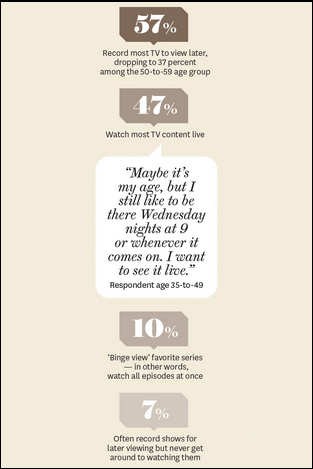
NPD Q1 13

When Fox introduced American Idol in the summer of 2002, the average American household had 102 television channels, compared to a whopping 181 channels ten years later.  Other developments in the media landscape, such as the growth of DVRs and Video on Demand services, the development of YouTube and other sources of streaming video and audio, the emergence of new venues for original series, and the massive growth of mobile technology and social media have had an impact on the television industry.

An article at the Hollywood Reporter argued that the television industry needs a “Steve Jobs – like visionary and needs it soon.”  While television networks have been slowly adapting to the changes in viewer behavior, they have not been considered particularly viewer friendly.

roku-apple-transparent-214x300While the film industry continues to see profound changes in the way movies are produced, distributed and monetized, the television industry is experiencing its own major shifts.  Viewers have been drifting away from viewing television in real time in favor of recording things on their DVRs and “hopping” through the commercials, or jumping on the cord-cutting bandwagon and consuming series television entirely online or through new technologies such as Roku or AppleTV.

Traditional Nielsen television ratings no longer portray a complete representation of the audience for a program, cable channels have caught up with the big networks and more and more outlets for original series (like Netflix, DirecTV and Amazon) are materializing with desirous offerings, tantamount to what’s being broadcast over traditional airwaves.

Screen Shot 2014-02-09 at 7.09.28 AM

FOX Chief Operating Officer, Joe Earley.

Joe Earley, the network poured over the ratings for its new fall shows and one trend stuck out in a big way: almost one-third of all viewers who watched Fox Tuesday night sitcoms did so via DVR, and because those viewers weren’t just sitting back and watching whatever show was up next, other new sitcoms on the Fox lineup didn’t exist.  Fox executives thought people weren’t rejecting these other shows but instead were just not watching them.  “We began talking about how we might be in a new world where we had to tell people to set their DVRs,” Earley told Vulture in a January 2013 interview with Josef Adalian.

Most television networks use Nielsen‘s Live Plus service to track viewer ratings.  Live Plus depicts who watched shows on their DVRs within different time frames.  Generally, it tracks three major categories: Live-Plus-Same-Day, Live-Plus-Three and Live-Plus-Seven, with each one tracking a broader time frame.  Live-Plus-Same-Day looks not only at who was watching when the show aired, but measure a program’s DVR viewing until 3:00am local time, that night.  Live-Plus-Three and Live-Plus-Seven track who watched within three, and seven days of the original airing, respectively, and although the Live-Plus-Seven ratings are the closest thing to a “true popularity,” from Nielsen, they’re not available until three weeks after the show originally aired.

When Nielsen first rolled out its Live Plus service, network executives were uncertain, but it’s become an industry standard.  These Live Plus ratings can make a big difference when a large portion of a show’s fans is watching on their DVRs.  For more information about Nielsen‘s television ratings, click here, and to hear it directly from the horse’s mouth, click here.

Now, armed with Nielsen’s  “special DVR data,” television executives are trumpeting the big viewership gains their shows are seeing up to a week after original air dates. This DVR data has become an increasingly important part of the calculations as each network decides which new fall shows to keep, and which to axe.

201-008-following-resurrection-photos-lightbox-tbd

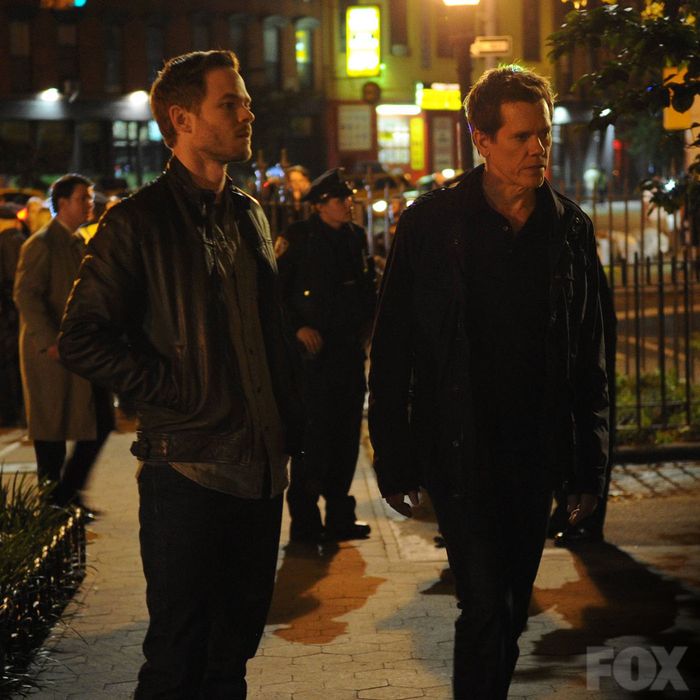
Shawn Ashmore and Kevin Bacon as Mike Weston and Ryan Harding in FOX’s serial-killer thriller, “The Following,” airing Mondays 9/8c

Rather than begin blanketing its airwaves and commercials with  “Love Your DVR” PSAs, Fox executives decided to experiment using “The Following” as a guinea pig.  Their submission to rampant DVR use by American households paid off, with the freshman thriller jumping 34 percent in the wake of the premiere in 2013.  “We want people to be there from the beginning of the series,” Earley explained in his interview with Adalian, of Vulture.  “We don’t necessarily want to encourage people to delay viewing.  But we also don’t want them to miss it.”

Sleepy Hollow,” Fox’s fall 2014 millennial spin on Washington Irving’s classic tale (for full text, click here), saw a huge impact on viewership once the DVR viewers were added to the mix.  The premiere audience rose from a moderate 8.6 million to a vigorous 13.5 million viewers.

Fox was the first broadcast network to integrate DVR messaging into a promotional campaign for a new television series, but it appears to have become more common as time-shifting continues to impact how we watch “our stories.”

Advertising and DVR message integration isn’t the only way in which Fox is dealing with the disruption of the “glory days” of media conglomerate’s business practices and audience viewership ratings.  FX President John Landgraf and Fox Chairman of Entertainment Kevin Reilly, are looking at ways to modify their networks, both owned by Fox Broadcasting Company, for a changing media landscape.

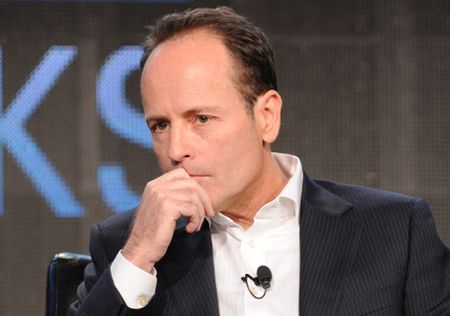
john-landgraf

President of FX Networks, John Landgraf

Landgraf, who is touted as one of the smartest executives in television, by Chief TV Critic Tim Goodman (@BastardMachine) of the Hollywood Reporter, observed that 2013 was a year in which cable series like AMC‘s “The Walking Dead,” FX‘s “Sons of Anarchy” and A&E‘s “Duck Dynasty” were in the 20 most watched shows, and that scripted series, were particularly exploding.

“In 2002 when we launched ‘The Shield,’ there were 33 scripted dramas or comedies on basic and premium cable,” Landgraf told Alison Willmore (@alisonwillmore) TV Editor at IndieWire during the Winter 2014 Television Critics Association Press Tour.  “This year there will be about 180. That is over a 500% increase.  And it doesn’t account for the fact that Internet delivered TV services like Netflix, Amazon Prime and Hulu Plus are now rolling out their own original series.”  However, Landgraf doesn’t see an increase in series competition as FX’s biggest challenge –  ”Somehow our shows seem to keep hitting all time highs every year.”

Sons-Of-Anarchy-sons-of-anarchy-2878455-1024-768-12

FX Original Series “Sons of Anarchy,” starring Charlie Hunnam.

Rather, the chief obstacle he sees is that as viewing habits change, the networks are experiencing a huge loss of advertising revenue.  For example, FX’s original series, “Sons of Anarchy” season premiere earned over five million adult viewers ages 18 to 49, but only two million of those were watching it live and only three million watched the commercials.  FX’s response to this disruption has been to create an On Demand streaming service called FXNow, but also to produce more of their original programming.

Landgraf argued that television series are no longer “a disposable medium” in which the shows are made predominantly for the viewers that watch it in real time.  ”Now I think we’re making shows for posterity,” he told Indiewire.

“That’s the thing that’s most exciting to me about television,” Landgraf expounded, “is that now television seems like a medium that has a long life. Therefore, it’s worth making things that not only galvanize an audience the night they air, but might be useful to someone 15 or 20 years later. And, of course, we own most of our programming, so we’re benefiting from both those revenue streams.”  In addition, he noted that “the number of times when there were challenges over here on the ad sales front, the ownership of content has bailed us out.  So it’s a nice thing, actually, to have some sort of more certain long tail revenue that sort of undergirds a more volatile thing like advertising sales.”

kevinreilly_2013_verite_652_top_story

FOX Chairman of Entertainment, Kevin Reilly.

One of the ways Fox is dealing with the changing realities of the TV landscape is by bypassing the traditional pilot season, according to Kevin Reilly, Fox’s Chairman of Entertainment.  Networks normally take pitches for new television shows in the early summer, order scripts in the early fall, and pilots in January.  However, most of these pilots never get any closer to becoming a new series September or January.

“The broadcast, development, and scheduling system was built for a different era,” Reilly explained to Willmore of Indiewire, calling it “highly inefficient” to take place on a randomly compressed period and rigid schedule.  He noted that cable networks have “a lot of flexibility in when the shows can go on” and that they “are able to course correct creatively and reshoot and recast.”

Fox has begun ordering multiple series throughout the year and at any given point are in some stage of production on at least 9 separate projects.  Reilly believes this change will be “more talent friendly” and will allow more year-round programming and more flexible season lengths, making Fox comparable to the cable networks.  “There shouldn’t be a set order pattern,” he said.  “There shouldn’t be a set time when we launch things.  There are thousands of original shows competing for attention right now — we just can’t do it all at once.”

24-Live-Another-Day-Super-Bowl-Promo-320x180

#JACKISBACK
24:Live Another Day returns 5-5-14 to FOX

Fox will begin its new scheduling system this year by rolling out 12-episode miniseries “24: Live Another Day” in May, when series are historically winding down.  It will also begin slating some of its new series to begin next summer, instead of in the fall.  Reilly noted that they have been starting shows earlier in the year in order to give the shows more room to rework potential issues.  “It’s not a big story when cable rolls back a premiere date,” he explained to Indiewire.  “There’s barely an HBO show that doesn’t reshoot half of their pilot every time, and no one throws their arms up about that.  That’s how you make things great.  We want to have that same maneuvering ability.”

Fox’s aforementioned surprise hit of fall 2013, “Sleepy Hollow,” was a 13-episode season, and they’re not currently looking to change the number of episodes ordered for its second season.  “I think for most shows and dramas in this day and age, it’s better for the audiences to focus and to do shorter orders,” Reilly said.  “Many dramas are just better creatively on a shorter-order pattern.”  However, this year’s change to the scheduling system means, Fox will be starting next year’s production of “Sleepy Hollow” in March and will be months ahead of any other network, according to Reilly.

Fox Broadcasting Company has also caused the media landscape some disruption of its own by being one of the first networks to honestly address the issue of diversity in television programming.  Fox initially began talking about diversity as a business imperative three years ago; shifting the conversation to the need for TV programming that reflects the multicultural reality of today’s world to keep younger viewers.  It has since held annual conferences on diversity, telling top show producers that their casts and crew had to feature more people of color.  The Deadline Hollywood blog reported on the 2013 event, held this past October for more than 150 people including representatives from the top talent agencies, Def Jam Recordings co-founder Russell Simmons, and top executives from several Fox television, film and business divisions.

Television viewers are more likely to watch shows that employ racially diverse casts and writers, according to a study done at UCLA’s Ralph J. Bunche Center for African American Studies.  The study is the first in a series of analyses that will be done for the center’s Hollywood Advancement Project.  The project will track over time whether the TV-and-film industry is “employing diverse groups of lead actors, writers, directors, producers and talent agents, and it will identify best practices for widening the pipeline for underrepresented groups,” according to its website.

In an analysis of more than 1,000 television shows that aired on 67 cable and broadcast networks during the 2011–12 season, UCLA researchers studying racial diversity in the entertainment industry found that more viewers were drawn to shows with ethnically diverse lead cast members and writers, while shows reflecting less diversity in their credits attracted smaller audiences.

“Diversity is the new ka-ching.  “Not only are you going to have more chances of a show being made here, more chances of a show being a success on TV, more chances of making it into syndication, more chances of a show selling globally and making you millions of dollars, but you are going to bring more viewers to our air and keep us in business,” Fox Broadcasting COO Joe Earley announced to the “Seizing Opportunities” diversity event guests at Zanuck Theater on the Fox lot in 2013.

“Fox has managed to quietly introduce some of the most well-rounded roles for black men in the last decade—and this year’s slate of new shows goes even further.  Outside of Shonda Rhimes’ deliberately diverse casting on ABC, Fox is the least whitewashed broadcast network of the four heavyweight media giants, and it hasn’t stopped there,” wrote Sonia Saraiya (@soniasaraiya), Assistant TV Club Editor for the A.V. Club blog, in a November 2013 article.

Fox’s new revolutionarily diverse casting work has created some of the strongest and most refined roles for men and women of color in television, and has helped to produce critically acclaimed shows that are garnering significant viewership and accolades for their focus on authenticity and complex character.

TV Critic Eric Deggans reports in the NPR blog CodeSwitch that Fox’s openly acknowledged business decision to hire more diverse casts has not only helped redefine the roles of black women on a television series, but has helped create new storylines with fresh perspectives, as in the case of Fox’s “Sleepy Hollow.”

111-003-sleepy-hollow-vessel-photos-lightbox-tbd

Nicole Beharie, Tom Mison, and Lyndie Greenwood in FOX’s “Sleepy Hollow.”

“When the show featured a storyline centered on Mills’ sister, we got to see two black women in an action/adventure setting, fighting the bad guys instead of waiting to be rescued or seduced,” Deggans wrote in his November 2013 article for CodeSwitch.  “It was exactly the kind of diverse casting I had been waiting for since 1999, when the issue hit a crisis point as the broadcast networks offered a fall slate of new TV shows without a single character of color.”

Sleepy Hollow’s” supernatural drama, complete with a Four Horseman of the Apocalypse crime fighting plot, is anchored by the character of Abbie Mills.  A strong, young female police officer, played by an up-and-coming African-American actor, Nicole Beharie, the character gets to kick down doors, carry her trusty sidearm, and play a skeptical but smart lead role.

Deggans added that “an upcoming episode will find the duo facing the legacy of slavery — a storyline that a more old-fashioned network series might have glossed over now has a new twist with an African-American co-lead.”

Fox Broadcasting Company’s recognition of the shift in viewer’s desire towards more racially diverse casts and the need for more authentically diverse roles in television programming is in part because of its newly created Audience Strategy division.  According to its website, this division of the Fox Group “develops and implements transformative strategies to catalyze a cultural shift in the industry, embracing a multi-pronged approach of working from the inside-out to drive behavioral change and outside-in to advocate for diverse perspectives, and to engage all audiences in our multicultural world.”

The Fox Writers Intensive, a highly selective writer’s initiative held at the Fox Studios in Los Angeles, CA, from January 2014 through May 2014, is just one of the many strategies Fox is employing to help maintain its multicultural perspective.  The Intensive is designed to introduce experienced writers with unique voices, backgrounds, life, and professional experiences that reflect the diverse perspectives of the Fox audiences to a wide range of Fox showrunners, writers, directors, screenwriters and creative executives.  “These collective individuals work with the selected writers in a series of master classes to build on both their general craft and further their skillsets in the business of writing for television, feature films and digital content, according to the Fox Writer’s Intensive FAQ on its website.
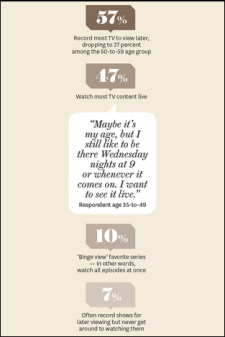
Screen Shot 2014-02-09 at 7.46.25 AMTechnology never remains static for long and often moves in unexpected ways, as we’ve seen in the television and news industries.   This case study addressed some of the ways that Fox has modified its schedules, strategies, and behaviors due to the variety of transformations broadcast has gone through in the past decade with satellite, cable and on-demand irrevocably altering our viewing habits.

However, more recently mobile is starting to transform the face of broadcast and the on-demand model that we have quickly become accustomed to will soon to be complemented with “on-the-go” and “interactive” models, enabled by the ever-increasing sophistication of mobile solutions.  With the number of mobile-connected devices soon due to exceed the number of people on earth, broadcasters must respond to even more changes in viewing habits to meet consumers’ expectations of experiencing a more engaging, interactive and tailored broadcast experience.

It will be interesting to see what new techniques Fox will employ in order to continue to adapt in the continuously changing media landscape and to any new disruptions caused by the extreme growth of new mobile technologies.


Photo365 Challenge – Day 18

Image

Bonono gives a book review on “Statistics for People (Who Think) They Hate Statistics.”  Thumbs DOWN!

Bonono is not amused…. neither am I 

We may not make it through this Photo365 Challenge if we have to continue reading stuff like this….

PhotoGrid_1391547390997


Remember:  In the coming weeks, you may see pictures of The Adventures of Bonono and Bones.  Bones, a puppy, is Bonono’s pal and companion in crime.
Currently, Bones is working on his own Photo365 Challenge.  If you’re interested in seeing what he is up to, follow him by clicking here.

Photo365 Challenge – Day 17

Image

I caught Bonono sitting too close to the TV.  He refuses to back away even though I’ve told him to.  

So far, no monkeys have been beaten by mommy during this Photo365 Challenge.  

PhotoGrid_1391546542683

Remember:  In the coming weeks, you may see pictures of The Adventures of Bonono and Bones.  Bones, a puppy, is Bonono’s pal and companion in crime.
Currently, Bones is working on his own Photo365 Challenge.  If you’re interested in seeing what he is up to, follow him by clicking here.

Photo365 Challenge – Day 16

Image

Bonono made a collage of his #puppybowl viewing for Day 16.

He is really enjoying the photo editing aspect of this Photo365 Challenge.  

PhotoGrid_1391547082503

Remember:  In the coming weeks, you may see pictures of The Adventures of Bonono and Bones.  Bones, a puppy, is Bonono’s pal and companion in crime.
Currently, Bones is working on his own Photo365 Challenge.  If you’re interested in seeing what he is up to, follow him by clicking here.

Journal # 3 – Topic Blog Influencers

Standard

Topic Blog Influencers

Screen Shot 2014-02-05 at 6.56.51 PM

“Develop a list of at LEAST three other blogs or Web sites that meaningfully address your topic of interest.  For professionals, a blog is often a “hub” for other social media activity occurring around the web. Summarize and evaluate some of the key features of each blog or site using bullet points on your journal blog.

Answer all of the following questions: What kind of problem do these websites/blogs help solve for their audience and/or what needs do they fulfill? What do they do well? What could they improve? Can you identify any gaps in their content or features that a competitor could fill, and how is what you could offer different or better? Look at their social media presence and the comments or interaction they get: Are they cultivating an active community around their site?”


My Topic Blog, TN Liberty, is a forum in which to share information about news, events, politics, and laws concerning our state. All conservative and liberty-minded activists, students, campus and community leaders, and voters, are encouraged to contribute. TN Liberty, is also a location for resources concerning bills up for approval, TN Congressional representative’s contact information, statewide and county events, activism advice, mentorship, and grassroots training, among other issues as needed and requested. TN Liberty serves as an extension of the TN and MS Leadership page on Facebook and may ultimately be followed with a MS Liberty blog. There are contributing writers on topics concerning the Liberty Movement in Tennessee, liberty-minded issues, and various opinion columns.

For this assignment I started by searching for other bloggers who are advancing the liberty movement. I found that many of these sites were highly specialized and a little on the fringe. That is not the type of blog that I want TN Liberty to be. I feel that it should be specialized by pertaining to the state of Tennessee, but it should also contain information about why the Liberty Movement is so important, how our government is violating the Constitution, and what actions a citizen, can take to advocate for Liberty and Freedom.

Next, I found an interesting site that ranked the top libertarian leaning (or liberty-minded so as not to be confused with the Libertarian Party) websites according to Alexa and Compete.

Here I settled on several top ranking and well-known liberty-minded sites to which I could make some comparisons.

They are as follows:

Reason

The Liberty Paper

The Liberty Crier


Let’s start with Reason.

This slideshow requires JavaScript.

  • Reason is the monthly print magazine of ‘free minds and free markets.'”
  • “It covers politics, culture, and ideas through a provocative mix of news, analysis, commentary, and reviews.”
  • Reason provides a refreshing alternative to right-wing and left-wing opinion magazines by making a principled case for liberty and individual choice in all areas of human activity.”
  • Reason.com is updated daily with articles and columns on current developments in politics and culture. It also contains the full text of past issues of the print edition of Reason.”
  • At first glance, reason.com looks a little messy in terms of visual appearance.  A little cluttered and although I understand that this is because the site’s home page is the first stop for ReasonTV, Reason24/7, the Hit & Run Blog, and stories from the printed magazine, as well as the location for Top News Stories (sortable by Featured and New) and a lot of advertisements.
  • Reason is financially backed by a national non-profit and thus, has the ability to aggregate thousands of news stories as well as employ a staff of over 50 for the website.  However, I believe they could significantly improve their website by maximizing the white space and uncluttering the articles.  It could look much cleaner.  Once you click on the headings for the different sites within the site, they pages get a bit cleaner and more visually appealing.
  • TN Liberty is a more more localized blog/site and will not need to run every single news story and headline that potentially has anything to do with liberty or liberty politics.
  • Reason does enjoy a fabulous social media presence with stories and photos shared through their Facebook  page and on their Twitter each day.  On Twitter, Reason has over 130K followers and on Facebook, over 125K likes.

Next, we examine The Liberty Paper:

This slideshow requires JavaScript.

  • The Liberty Paper  is a web-based news site commentating and reporting on legislation and events, which affect the American peoples’ liberty domestic and abroad.”
  • The Liberty Paper was launched in the summer of 2012, by political commentator and legislative lobbyist, Michael Lotfi.”
  • “To date, TheLibertyPaper.org has enjoyed an ever-growing, loyal fan base, which has generated hundreds of thousands of readers in more than 140 countries around the world.”
  •  TheLibertyPaper.org is updated only semi-regularly with articles and columns on current developments in politics and culture. If you look at the current home page, you will see that the most recent article posted is from January 27th, 2014.
  • TheLibertyPaper.org is also riddled with advertisements and donate here boxes.  I understand why Michael Lofti would choose to accept advertising and donations – hopefully, someday soon, the TN Liberty blog will also accept advertisements and donations.  However, I feel the visual esthetics of the site could be cleaner and the ad placements more controlled.
  • TheLibertyPaper.org is run by a friend of mine.  He is a recent graduate of Belmont College in Nashville, TN and a well-known activist in the state.  However, I have mixed opinions of his work, his self-promotion, and his ability as a journalist.  Each story is riddled with grammatical errors to say the least.  He was also given a column at the Washington Post.  On his first article, there were complications and the post was ultimately removed due to his lack of due diligence and his reporting false information.
  • TN Liberty is will certainly provide a more grammatically correct site as well as one that is more visually appealing.  However, it will not focus as heavily on National stories and investigative muckracking.  I hope to provide a forum in which concerned residents of the state can ask for advice as well as receive news – especially that which is most pertinent to their area.
  • TheLibertyPaper.org does have a social media presence with stories and photos shared through their Facebook  page and but no Twitter as far as I can find.   On Facebook, it has just a little over 4K likes.

Finally, let’s take a look at The Liberty Crier:

This slideshow requires JavaScript.

  •  The Liberty Crier is updated daily with articles and columns on current developments in politics and culture. If you look at the current home page, you will see that the a rotating Top Story Box
  • The Liberty Crier is a very visually appealing blog sites with a lot of features.  The masthead is clean and displayed prominently.

Screen Shot 2014-02-05 at 6.13.56 PM

  • Some other interesting aspects that The Liberty Crier features are categories for:

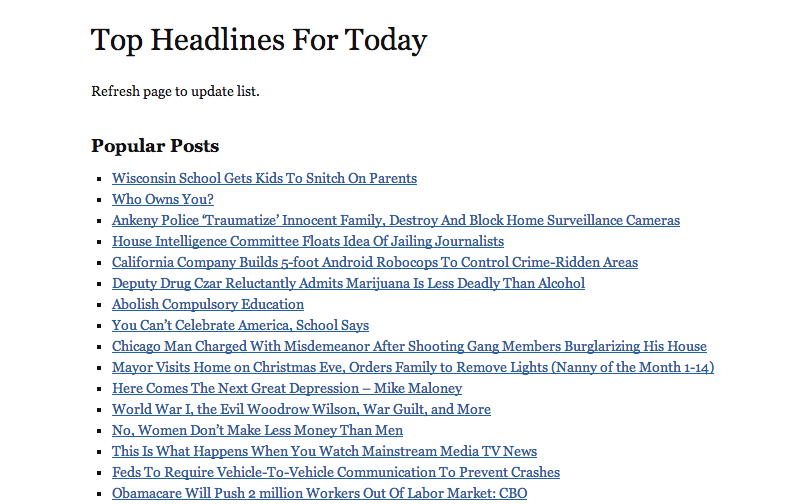
1. Top Headlines

Screen Shot 2014-02-05 at 6.17.32 PM

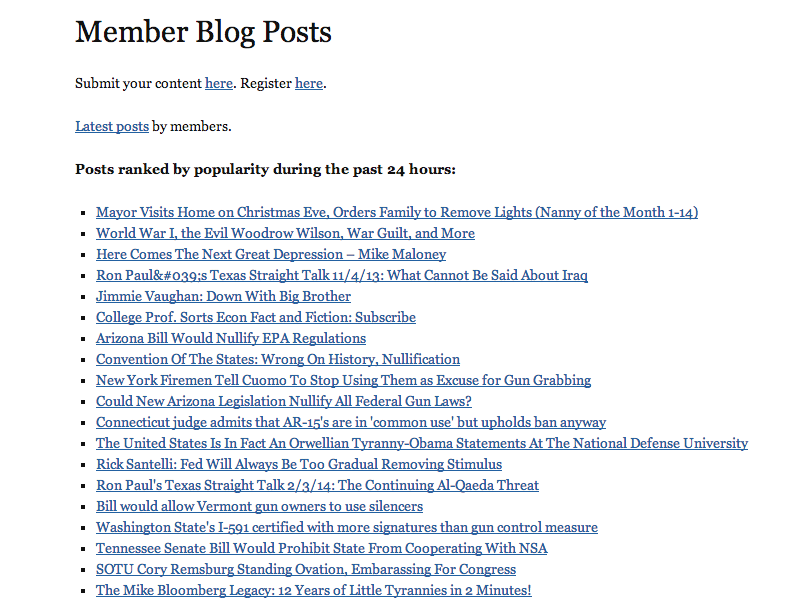
2.  Member Blog Posts

Screen Shot 2014-02-05 at 6.03.00 PM

3.  Documentaries

Screen Shot 2014-02-05 at 6.03.27 PM

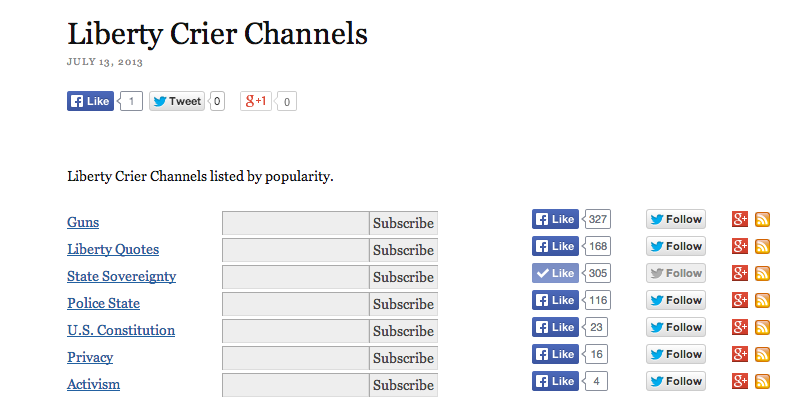
4.  Channels

Screen Shot 2014-02-05 at 6.02.34 PM

  •  The Liberty Crier seems a bit lacking in their social media presence with their Twitter receiving only 1200 followers.  Their Facebook page has only 8.9K likes.  This seems rather odd to me because it is not being a new website.
  •  I envision the TN Liberty blog looking closer to this blog/site than any of the others in this review/comparison.  I also plan to add a forum for discussions among Tennessee residents and allow for contributing writers as well.  The main difference will be that TN Liberty will be localized plus – it will have a much bigger social media presence.


Photo365 Challenge – Day 15

Image

I caught Bonono taking a few selfies to add to this Photo365 Challenge.

IMAG0652_1

Remember:  In the coming weeks, you may see pictures of The Adventures of Bonono and Bones.  Bones, a puppy, is Bonono’s pal and companion in crime.
Currently, Bones is working on his own Photo365 Challenge.  If you’re interested in seeing what he is up to, follow him by clicking here.

Weekly Reading Ramblings – Week 2

Standard

Robin Rambling on Week 2 Readings

Social media


I know exactly how Anne Trebek feels. No, i’m not a book editor or a literary critic. I don’t live in Cleveland or mingle among the literary and academic elite. I do, however, use Twitter…and Facebook…and Tumblr…and any other social medium that allows me to connect with people. People who share my passion for liberty, freedom, Ron Paul, education, journalism, animal rescue, travel, and about a million other hobbies and interests. In the past two years, I have been lucky enough to meet people, experience opportunities, and open doors that would have remained closed, if it weren’t for the vast reach and power of the internet’s social networking capabilities.

In “Only the Literary Elite Can Afford Not to Tweet” in SFGate,  Trubek explores the upside to being a member of a social media community.  She is an avant Twitter user and although, Twitter isn’t my favorite social networking site, it’s in my top three. I can easily see the Twitter appeal and it has helped boost my number of career connections, tenfold. Truth be told, it’s Twitter’s stringent 140 character limit that secures it’s number two spot on my favorite’s list. I know that comes as a shock to those of you who know me, but it’s not all about my lack of brevity. In order to be concise while Tweeting, one must use the “&” symbol and abbreviate words. My academic training rears its ugly head and that voice inside of me screams “NOoooooooo” whenever I begin to substitute symbols and abbreviations for words. I suppose it’s no longer the cardinal sin it once was and that just because I’m able to tweet using symbols and abbreviations doesn’t mean that i’m any closer to losing the ability to spell out words like “love,” “for,” and “you” with the teenage millennial substitutions of “luv,” “4,” and “u”. So far, I’ve managed to keep a significant number of followers while only using the abbreviated syntax sparingly.

Trubek noted that because of social media’s vast reach, she was able to gain an “intellectual community” that she otherwise lacked in her daily life. I can certainly relate. My local friends are by no means stupid, but many do not share my interests or passions – and if they do – there is a significant difference in our intensity levels. Now, that I have made my passion my work, it is nice to live two lives to some degree, as Trubek suggests. At her office, she “mingles” with intellectual equals who are eager to participate in conversations pertaining to her passion – editing, but when she closes her office door and opens her front door every evening, fulfilled by her work and her community, she is comfortable letting her other interests run free.

Growing up without the connectivity of the internet, I didn’t realize how big of a change it could make in one’s life until recently. After obtaining an Advertising degree and struggling to find work that didn’t feel like work, I began to question how I would be able to find happiness in a career for the next 50 years. I hated everything about the day to day and was disturbed about the lack of fulfilling jobs available in this city. One day, that all changed and it wasn’t until I read Anne Trubek’s words that I realized the debt I owed Facebook and Twitter. She is right – with social networking sites people are less judgemental. Even though physical appearance is part of that, I’m not talking about a “catfish” scenario. People of all ages can become friends and colleagues through Facebook and Twitter. In fact, one of my best friends, and fellow activists, lives right here in Memphis but I met her originally on Facebook. Her youngest son is a college student at the University of Memphis and she is 15-20 years my elder. I’ve actually never asked her age specifically, because it mattered so very little. However, I truly believe that without social media being our first connection – we would’ve never gravitated to each other. If meetings and networking events had been our first introduction, the categorical differences would’ve placed us in separate “groups.” Social media can act as a “leveller” in many ways. I have been able to change career paths and have conversations with cutting-edge influencers who give me the same respect as they give a 20-year political campaign veteran.

Next, Trubek addresses social media self-promotion. Many critics, with beliefs similar to Jonathan Franzen’s, consider garnering publicity for oneself through social media channels to be a new form of bragging and boasting – and it can be but it isn’t a cut and dry as they make it sound. I find the methods in which some self-promote to be arrogant and flamboyant. That doesn’t mean that all social media self-promotion is arrogant and flamboyant – in fact, if done correctly and with class – it won’t be a turn off, it will be a turn on – garnering you the attention you deserve. There will always be the “used car salesmen” of the internet but that doesn’t mean you have emulate their actions – there are plenty of ways to promote yourself, without selling yourself.


This week’s readings were very Twitter-ful and helped to give guidance in the art of Twittering. Okay, so you caught me. I’m trying to be cute because it’s easier than going through four articles on different standards and processes for one’s use of Twitter.

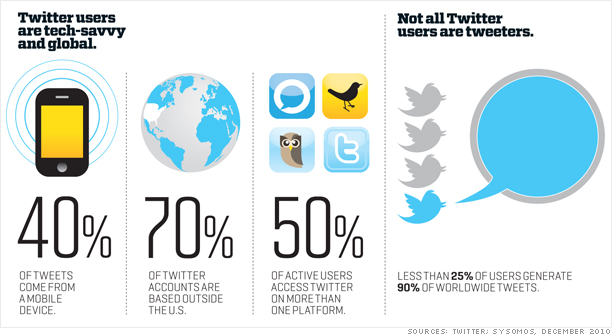
twitter_numbers1


In “Storyful’s Validation Process” by Malachy Browne, he walks the reader through a series of steps that could help a journalist in the digital age of information ascertain the verifiable truth. First, he notes the mantra “there is always someone closer to the source,” and goes on to explain that journalist’s you should always try to locate the original source of any videos. Fair enough, you say? Exactly – wouldn’t most people do this? Well, one would think so but honestly, I’ve seen so many incorrect and false posts on Facebook that reliable sources just re-posted without verifying – I have come to realize the answer is No, most people wouldn’t do this. They would assume it was the truth, and we all know what happens when you assume. Browne explains the multitude of techniques that you can use such as examining the embedded data within the images, cross-referencing the video uploader’s social media accounts for location, reliability, bias, and length of existence, as well as consistent video quality and number of close friends, and checking the video descriptions for any telling information such as a date or a specific location or IP address.

Next, Browne gives an example of a video posted to YouTube that shows residents of coastal Meulaboh, Aceh fleeing from the April 11th, 2012 tsunami. Storyful was able to verify the video uploader was from Meulaboh, that he had previously uploaded other videos from Meulaboh in the past six months, and that he was an active Twitter user and blogger, as well as verify the location in the footage through a visible sign that read “Meulaboh Lagoon.” They concluded that this video was in fact truth and because they verified that information, they could feel good about publishing it.

Browne delineates several other techniques that one could use to corroborate the content of a video before assuming its truth. Once the uploader has been assessed, he suggests that you focus on the content.  First, you ask the obvious questions such as does anything in the video look out of place and does it make sense in the filming context.  Then you move to the more detailed questions by examining the background of the video and checking for geo-tagging, landmarks or topographical data. One should also check to ensure that weather conditions in the footage match other reports for that given day including checking to see if the shadows that appear in the videos jive with the time of day that is reported. Next, Browne reminds you to check for accents or dialects that could create a disconnect between the people speaking in the video and the location in which it is supposedly filmed, as well as verifying that other users have mentioned the “event” in local news reports, news wires, twitter feeds and lists, or by posting other videos and images.

At first glance this looks like a lot of work and admittedly, it takes time as Browne suggests. However, as journalists it is our responsibility to gather and report the FACTS – not the potential facts. A few extra minutes spent doing due diligence could ultimately save you a lot of time trying to repair your reputation. The world doesn’t forgive journalists as easy as it forgives Justin Bieber.


Other Articles of Interest for this Week: