
#gradschool
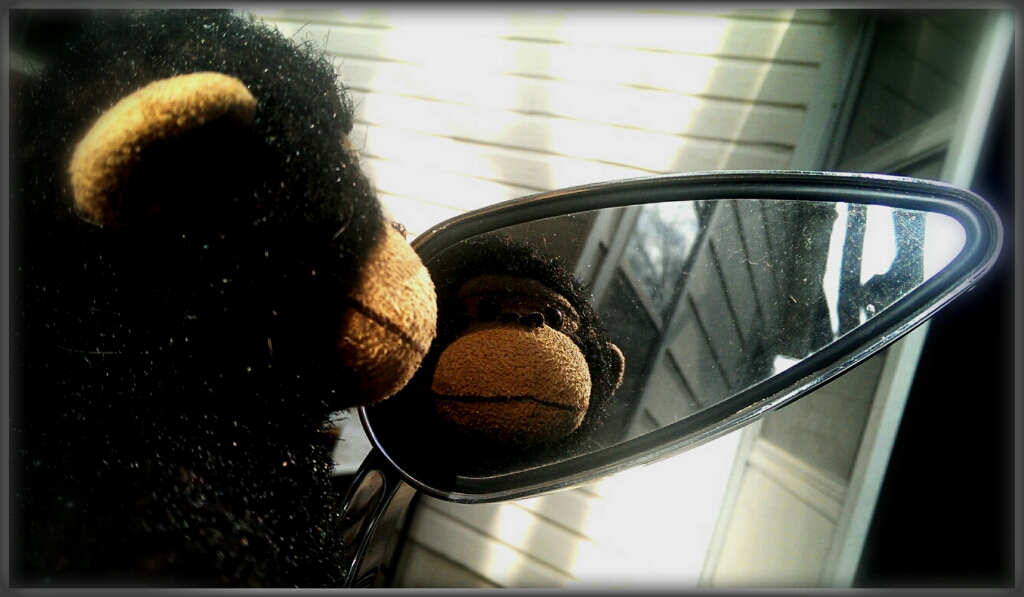
Photo365 Challenge – Day 26
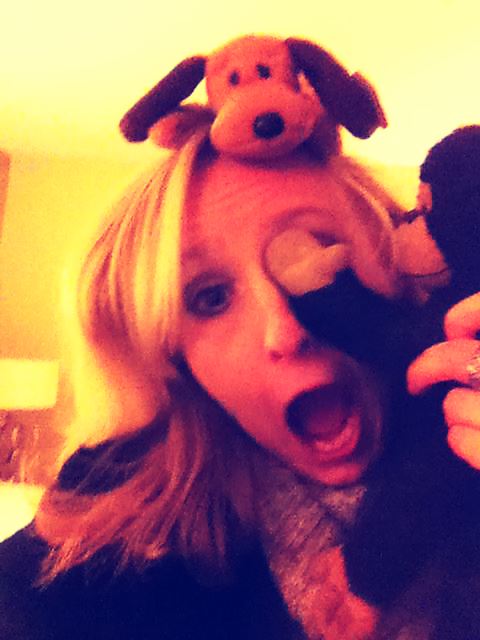
ImageSo Bonono decided to take two days off and disappear for the weekend! Thanks buddy – I guess i’ll just do your Photo365 Challenge for you again today! He’s lucky he is cute!
So – here’s a scrunchy-face selfie to let you know just how i’m feeling about ALL the things! If you know me, you know that I make this face a lot!
Eh…it’s a face only a mother could love.

Check back in everyday during this Photo365 Challenge to see more antics from Bonono (when he decides to get back to work).
Photo365 Challenge – Day 25
ImageGiving Bonono the day off from the Photo365 Challenge, I decided to upload a picture taken at the most awesome early birthday present event ever!
My mother purchased tickets to see Vicki Lawrence’s 40th Anniversary 2-Woman Show with “Mama” (aka Thelma Harper of Mama’s Family) at Resorts Casino Tunica!
It was a lot of fun to get to spend some time with my mother and “Mama” was hilarious as usual!
Click here to see some great Mama’s Family photos.

Check back in everyday during this Photo365 Challenge to see more from Bonono and me!
For you viewing pleasure check out Vicki Lawrence interviewing Thelma Harper and Carol Burnett, Betty White and Vicki Lawrence reminiscing about their time together on Mama’s Family:
Mama on Giving Birth in an episode of Mama’s Family:
Meet Bob – With Bob, You’re Never “Bowling Alone”
StandardA Startup Media Case Study by Robin Spielberger
Robert Putnam surveyed the decline of social capital in the United States in his 1995 essay entitled Bowling Alone: America’s Declining Social Capital and notes the aggregate loss in membership of many existing civic organizations. He points out that the act of individual membership has not migrated to other, succeeding organizations and to illustrate why this decline of citizen membership in social organizations is problematic to democracy, Putnam uses bowling as an example. He noticed that bowling leagues had declined significantly in the last few decades of the twentieth century. However, people still bowled, only now as individuals and informal groups, and not as part of a league. If people bowl alone, they aren’t participating in social interactions and civic discussions, which might occur in a league environment. Putnam looks to the technological “individualizing” of our leisure time via television and Internet as possible changes in American behavior that have led to this decline of social interaction.
 The average American over the age of 2 spends more than 34 hours a week watching live television, says a 2012 Nielsen report — plus another three to six hours watching recorded programs. The survey, taken during the first quarter of 2012, says average weekly viewing time hasn’t changed much over the last four years but the biggest change is that the time spent watching shows from DVRs has doubled, and more of us — 36 million, more or less — are watching video on our smartphones.
Concurrent with surveys of years past, Nielson concluded Americans watch more TV as we get older, with children age 2-11 watching an average of 24 hours of TV a week, or 31/2 hours a day. Teens, age 12-17, spend more than 22 hours each week engrossed in  television and 18-24 year olds spend more than 25 hours per week watching their favorite shows. After that, the numbers rise steadily until people over the age of 65 average 48 hours a week, or nearly seven hours a day glued to the tube.
Meanwhile, the average person spends approximately five hours a week trolling the Internet and those ages 35-49, spend more than seven. Certainly, this trend of solitary entertainment has led to less social interaction among family, friends, and communities. Who has time for it, after all?
Dov Moran, famed for inventing the USB flash drive, is at work on the next consumer revolution – this time in television – with his new company Meet-Bob.
Bob, a unique Android-based TV stick that enables families to communicate, share content, interact and play, all via the TV – no matter where each member may be physically located – was launched at the International Consumer Electronics Show (CES), a global consumer electronics and consumer technology trade show, in Las Vegas earlier this year. Bob promises to turn every television into a smart TV simply by connecting to an HDMI port.
 This new HDMI TV stick – called Bob and developed by Meet-Bob Ltd. – is designed to provide families with intuitive and exciting interactive communication options. It easily turns any TV into a content and communications mega-center, enabling family members to watch TV shows, movies or videos together; easily share favorite content and special moments with each other; keep-in-touch, using a webcam, and play games with one another – even if they are on different sides of the world. Bob can be easily carried anywhere, making any TV part of the family network. With Bob, you are no longer “bowling alone.”
 Bob makes user experience fully personalized by offering relevant features and content specifically created for each user profile. Every family member has a password-protected profile through the service, complete with a personal login and the interface can be controlled with a variety of devices, including a remote control and an Xbox– type controller.
 Children in the family will have access to specific features such as Video On Demand, live channels, games, apps, websites and educational books that have been parent approved. Parents will also have the ability to schedule viewing times and limit their children’s communication to only other family members.
The product name and slogan – “The stick that makes the family stick together” – were both chosen with the aim of making the device a part of the family. Lotan Levkowitz, vice president of Meet-Bob business development, explained to Todd Bishop at the CES in Las Vegas for his article in Geekwire, that the name is meant to evoke a friendly uncle who always wants to bring everyone together for a family picture or activities.
 Moran and his team believe Meet-Bob will revolutionize TV watching, said Sigalit Klimovsky, CEO of the Meet-Bob project in a January 2014 article by David Shamah of The Times of Israel’s Start-Up Israel section. “It’s a device to bring families together. Technology was supposed to get us closer; it has opened the boundaries and has become a commodity enabling us to communicate easily with anyone, anywhere. But while we connect more with a bigger group of people, we interact and communicate less with the people we care about – our family.” Bob, Klimovsky said, will harness interactive technology to bring people, especially families, closer together.
Inbal Orpaz states, “the idea is simple,” in her February 11, 2014 article in Haaretz, which named Meet-Bob the “Start-up of the Week. “Enable the TV to host all the digital content that’s important to one’s family, not just content that comes “packaged” via cable or satellite, Orpaz said. “The system allows families to communicate, share content, interact and play via the TV, regardless of where each member may be located.”
 Meet-Bob will not supply the television content itself; rather it will be a platform used by service providers and retail chains. This creates an exciting new opportunity for content providers, brands retailers, or any companies interested in extending their reach to the family living room, by providing a refreshing new family-oriented product offering unique marketing opportunities. The Bob stick enables the efficient delivery of content, the promotion of products and services, and micro-targeted campaigns directly to the family’s TV. You can distribute your own media content, such as Video On Demand, live channels, games, and books to any television set, as well as use the TV as an advertising platform, where you can launch micro targeted campaigns and efficiently promote products and services through family ties. Bob also gives you the tools to develop any type of interactive application and enable it at just the right time.
“Bob’s social nature and its unique interactive capabilities, allow it to target families in an entirely new way, strengthening brand loyalty, increasing viewer engagement and opening new revenue opportunities,” according to an article in Gadget, an online tech magazine.
 Orpaz gives another advantage for retailer and content providers but harkens a potential warning to those concerned about their privacy by noting that Bob “opens up new television advertising possibilities, thanks to the information that it can gather about viewers (gender, age, etc.), if users connect via Facebook, for example.”
The Android-based product will be sold as a kit that includes the Bob stick and a remote, however it will also be possible to control the television and access content via a smartphone or tablet application. Each stick contains a Wi-Fi antenna making it possible to put Web content on television. In addition to a retail version, Meet-Bob, Ltd, is seeking partners who will use the device to monetize content (like sporting events, live TV), offer interactive applications for users, develop micro-targeted TV ad campaigns for specific segments of the Meet-Bob user community, and so on
 At first glance, Bob looks a lot like Google’s Chromecast, which came to market last year and gives users the ability to stream videos from computers, or from YouTube and other services, to television sets. However, Bob is much more, said company spokesperson Iris Abramovich to Shamah. “Chromecast is just a video streamer, but Meet Bob is much more – actually a social and interactivity device, letting users communicate and participate with each other.”
 Moran’s Meet-Bob, Ltd, is an extremely new company founded late last year. Comigo, Meet-Bob’s sister company, also founded by Moran, expands the TV experience by extending viewing across all types of handheld devices. Moran serves as CEO of Meet-Bob, with four more employees joining its team from Comigo.
Bob Promo Video:
Hands on Bob:
Photo365 Challenge – Day 24
ImageBonono and Bones fell in love with this couch at the DoubleTree Hotel during their road trip to Nashville for the Tennessee Press Association Winter Conference.

Check back in everyday during this Photo365 Challenge to see more antics from Bonono (and Bones)!
Dont forget – Bones is currently working on his own Photo365 Challenge. If you’re interested in seeing what he is up to, follow him by clicking here.
Photo365 Challenge – Day 23
ImageBones was really kind and took a picture of Bonono and Me! I love my littlest monkey!
Check back in everyday during this Photo365 Challenge to see more antics from Bonono (and Bones)!
Dont forget – Bones is currently working on his own Photo365 Challenge. If you’re interested in seeing what he is up to, follow him by clicking here.
Weekly Reading Ramblings – Week 3
StandardRobin Rambling on Week 3 Readings

This week the readings, an article and several chapters of a book, written by two of the most well-known journalism and social media influencers in the county, Jay Rosen and Clay Shirky.
Before we begin, I want to take a few moments to introduce these influencers.
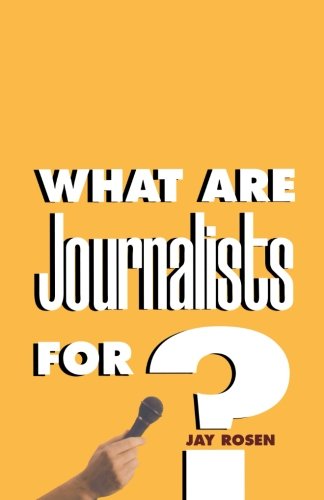
 Jay Rosen has been on the journalism faculty at New York University since 1986 and served as chair of the Department from 1999 to 2005. He has been one of the earliest advocates and supporters of citizen journalism, encouraging the press to take a more active interest in citizenship, improving public debate, and enhancing life. His book about the subject, What Are Journalists For? was published in 1999. Rosen is often described in the media as an intellectual leader of the movement of public journalism.
 Rosen writes frequently about issues in journalism and developments in the media. Media criticism and other articles by Rosen have appeared in The New York Times, The Los Angeles Times, Salon.com, Harper’s Magazine, and The Nation. He is also a semi-regular contributor to The Huffington Post.
He runs his own weblog called PressThink, which concentrates on what’s happening to journalism in the age of the internet and his writing for the weblog won the Reporters Without Borders Freedom Blog award in 2005.
 Clay Shirky, a writer, consultant and teacher on the social and economic effects of Internet technologies, has a joint appointment at New York University as a Distinguished Writer in Residence at the Arthur L. Carter Journalism Institute and Assistant Arts Professor in the New Media focused graduate Interactive Telecommunications Program (ITP). His courses address, among other things, the interrelated effects of the topology of social networks and technological networks, how our networks shape culture and vice-versa.
He has written and been interviewed about the Internet since 1996, with columns and writings that have appeared in Business 2.0, the New York Times, the Wall Street Journal, the Harvard Business Review and Wired.
His consulting practice is focused on the rise of decentralized technologies such as peer-to-peer, web services, and wireless networks that provide alternatives to the wired client–server infrastructure that characterizes the World Wide Web. He is also a member of the Wikimedia Foundation’s Advisory Board.
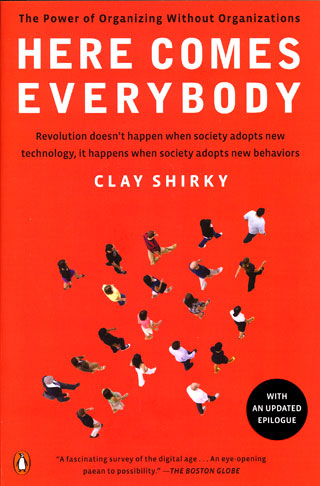 In his book Here Comes Everybody, Shirky explains his favoring
  of crowdsourcing and collaborative efforts online and uses the phrase “the Internet runs on love” to describe the nature of such collaborations.
In 2010 Shirky published Cognitive Surplus: Creativity and Generosity in a Connected Age which expands on themes introduced in Here Comes Everybody. The book follows concepts he introduced in a Web 2. 0 conference presentation April 23, 2008 called “Gin, Television, and Social Surplus.”
Shirky introduces Cognitive Surplus as a continuation of his work in Here Comes Everybody. “This book picks up where that one left off, starting with the observation that the wiring of humanity lets us treat free time as a shared global resource, and lets us design new kinds of participation and sharing that take advantage of that resource.”
Most recently, Shirky was featured in Journalism Degrees and Program’s article Best in #Journalism: 151 Twitters Worth a Follow by Sean Flynn. Beginning the section entitled “Professors,” at number 111, Shirky is considered to be one of the 18 Journalism Professors  worth following.
As an aside, my social media and entrepreneurial journalism professor Carrie Brown-Smith is featured at number 117, hanging in among the top heavy hitters in this new “business” of journalism. Check our her blog, The Changing Newsroom, to learn about cutting edge and entrepreneurial journalism.
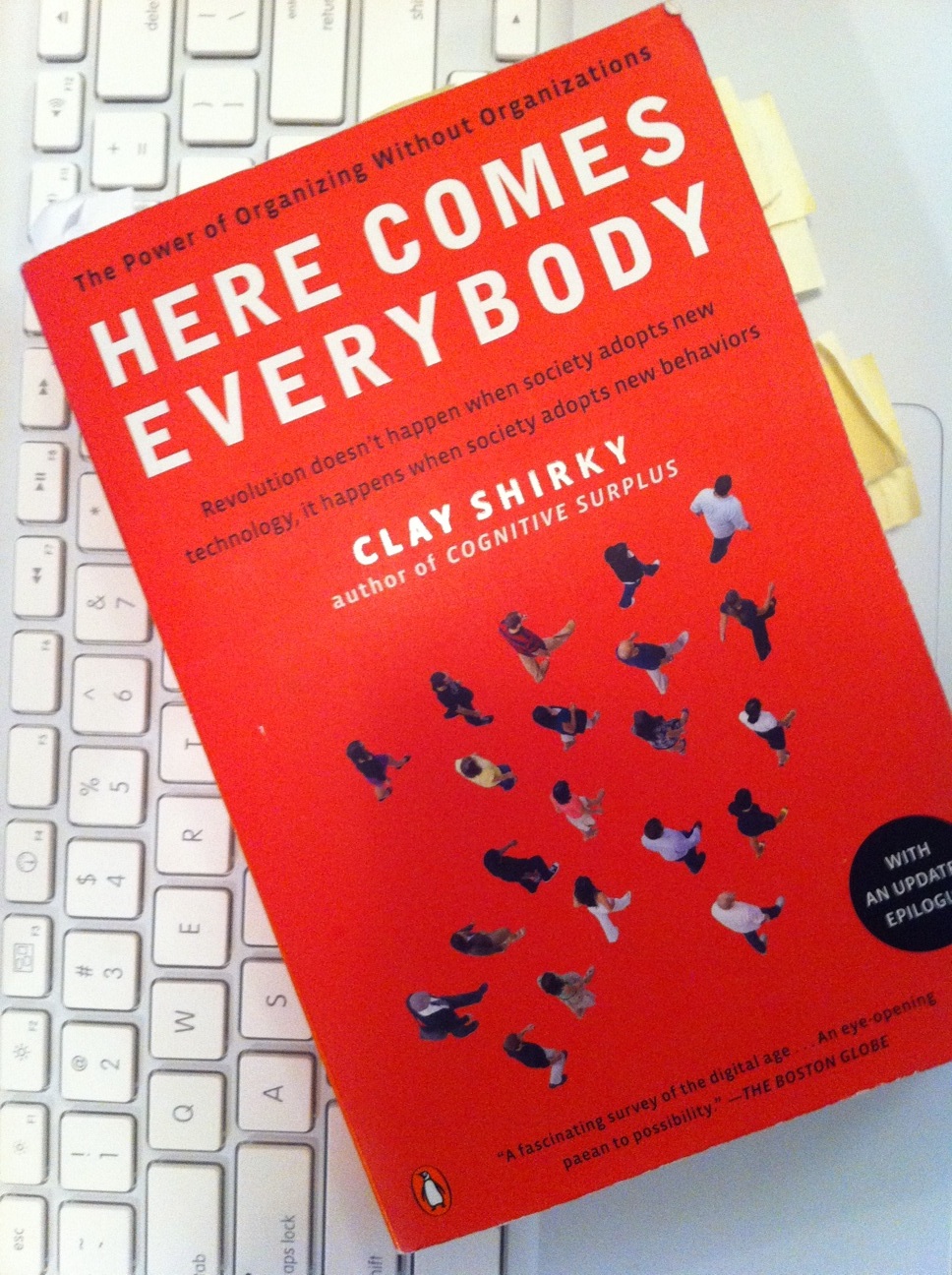 First, we will revisit the writings of Clay Shirky, this time commenting of Chapters 3-5 of Here Comes Everybody.
Shirky discusses the birthday speech given to Strom Thurmond in 2002 by long-time Mississippi Senator and former Senate Majority Leader, Trent Lott. In this section, he explains yet another example of how the internet has affected journalism. No longer do the journalists of major networks and newspapers single handedly decide what makes news, news. Today, due to the millions of bloggers and social media enthusiasts, any topic that a group of people find important enough, to discuss for long enough, can become mainstream news.
In the case of Trent Lott’s infamous speech, the majority of mainstream media failed to cover the speech because it was filed away under “not breaking news” due to the event being a simple birthday party. However, after the speech promoted Strom Thurmond’s 1948 overtly segregationist Presidential campaign and insulted the citizens of Mississippi by lumping them into the category of Strom supporters, bloggers took to their blogs, facebookers to their news feeds, and twitterers to their tweets in order to speak out against Lott’s actions and to, hopefully, distance themselves from such discriminatory implications.
For days, the “story” broke on the internet and the mainstream media took notice. I’m sure a bunch of “shoulda woulda couldas” were roaming the halls of every major newspaper and television station in the country, especially in the beltway. Unfortunately, at this point these traditional news outlets would’ve had to swallow their pride and make apologies for dismissing Lott’s speech and the birthday party when it happened, if they wanted to speak out against his chosen message.
Luckily, for the mainstream media, no one knows how to beat a dead horse like my fellow libertarians and libertarian republicans. My politically like-minded brethren are like dogs with bones when it comes to letting go of subjects they feel should be publicized. Trent Lott‘s speech happened to be one of these “bones” and according to Shirky, “because the weblogs kept the story alive, especially among libertarian Republicans, Lott eventually decided to react.”
Now, five days after the speech, the mainstream media wouldn’t have to swallow any pride or make amends. They could simply cover Lott‘s “halfhearted apology” for his statement and run footage of the original speech right next to it. This would open the subject up as “breaking news,” and allow for reporters and journalists to editorialize. No longer was defining “the news” as simple as Shirky said, “events that are newsworthy, and events that are covered by the press.”
Trent Lott’s Statement and Public Apology
Many have grumbled about this definition for years, complaining that some stories covered by the mainstream media are not newsworthy and that some newsworthy stories are not covered enough. Libertarians, and any other third party or even obscure issue groups, have been complaining about this “practice” for years. Why did so many serious topics go uncovered and so much “fluff” make it onto the front page? As Shirky pointed out, using the example of Trent Lott, this “link is now broken.” Shirky states, “From now on news cans break into public consciousness without the traditional press weighing in. Indeed, the news media can end up covering the story because something has broken into public consciousness via other means.”
As a blogger and social media user, with a journalism degree and a background in public relations, I am excited about this new frontier on which we are walking. However, as a political activist and holder of libertarian ideals, I have mixed emotions. Don’t get me wrong, the ability for the masses of people to publish information that the mainstream media either overlooks, dismisses, or hides is incredibly exciting and beneficial. The problem lies with the audience. Typical Americans of voting age, still receive most of their information from the mainstream media.
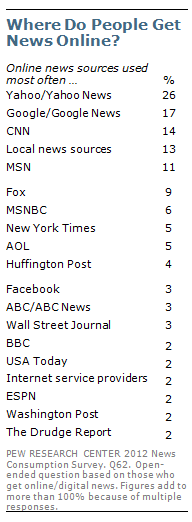 According to Pew Research Center for People & the Press‘ 2012 report, In Changing News Landscape, Even Television is Vulnerable: Trends in News Consumption: 1991-2012, despite a declining trend, “55% [of Americans] say they watched the news or a news program on television yesterday,” showing little change from recent years. This report also shows that “the overall share of Americans saying they regularly watch local television news has slipped from 54% in 2006 to 48% today – and in that regard it remains one of the news sources with the broadest reach.” Finally, Pew points out that 51% of those 65 and older say they regularly watch cable news and seven in ten (71%) say they watched television news, read a print newspaper or listened to radio news yesterday.
I find this highly disturbing. There are so many more sources of valuable information just sitting on the internet waiting for consumption. As an activist who volunteered in 2008 and worked for the 2012 Ron Paul campaign, I know that an idea planted, can sprout and grow just like a seed. In 2007, the word libertarian, much less the ideals of libertarianism, were not common knowledge. As the liberty movement grew, much in part to the efforts of Ron Paul, the political ideals became more common. This spread of ideals is owed in great part to the efforts on online bloggers and political activists. Shirky stated, “the same idea published in dozens or hundreds of places, can have an amplifying effect that outweighs the verdict from the smaller number of professional outlets.”
The liberty movement couldn’t be a better example of this idea. I noticed in early January of 2012, at the beginning of the Republican Presidential Primary, that the only candidate mentioning the issue of state’s rights, was none other than Ron Paul. This issue was verbally echoed by millions of his supporters and blogged by thousands in the coming weeks. By late February, on my 32nd birthday and during one of the Primary debates, every single candidate on stage mentioned the issue of state’s right in one form or another. It was blatantly obvious. Each candidate’s team had witnessed the growing support for state’s rights and in order to level the playing field, recommended that the candidate begin to show his support. I have witnessed the noise, firsthand, and resulting difference that a thousand blogging voices can make. However, it isn’t quick and it isn’t always eventually acknowledged.
With data showing a rise digital news consumption and a decline in traditional news consumption, the numbers of citizens who report blogs as their news source has maintained 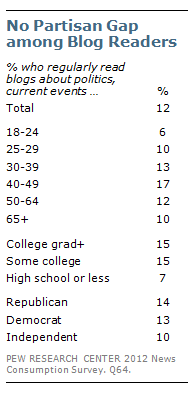 a relatively low response rate. According to the same Pew study mentioned earlier, “slightly more than one-in-ten (12%) of all Americans regularly read blogs about politics or current events and another 21% say they read them sometimes. Just less than half (45%) never read blogs or do not use the internet. The numbers of those who read blogs regularly are little changed since 2008.”
The report also shows that “among age groups, regular blog reading is lowest among those 18 to 24 (6%), . . . highest among those 40 to 49 (17%),” and little difference among the age groups in between. When readers are categorized by education level, “15% of college graduates and those who have had some college regularly read blogs, a number that falls to 7% for those with high school or less.”
I can’t help but wonder why so few people regularly receive news from blogs when so many citizens report that they trust all new sources similarly. One answer could be the sheer amount of information lurking on the world wide web and that people are simply overwhelmed by the options.
In 7 Things About The Mainstream Media That They Do Not Want You To Know, an article on Alex Jones‘ Infowars, Michael Snyder of The Economic Collapse states: “We live at a time when it is absolutely imperative to think for ourselves, but most Americans are being absolutely overwhelmed with information and seem more than content to let others do their thinking for them. Sadly, this is greatly contributing to the downfall of our society.”
Shirky’s theory of mass amateurization, the “result of the radical spread of expressive capabilities,” and the “comparisons between the neatness of traditional media and the  messiness of social media” is directly relevant to how Americans have become overwhelmed and symptomatically, uninterested. Shirky also noted that when comparing traditional media and social media in terms of neatness versus messiness, the system of filtering is often overlooked. In the process of traditional media publishing, there is a gatekeeper – an editor, or one who decides what should be printed and what stories to forgo. In social media and blogging, the user is the writer, the creator, the editor, and the publisher. No longer does the published word mean that someone else thought it was worth reading. When searching for news on the internet, today’s citizens must be filtering gurus because as Shirky stated, “mass amateurization of publishing, makes mass amateurization of filtering a forced move.” Filter-then-publish is a thing of the past. We live in a publish-then-filter society.
He uses the notion of picking up a bookstore and shaking it onto a football field to describe the contents of information on the web. Of course, you will see classics by such writers as Shakespeare, Fitzgerald, Chaucer, Hemingway, Tolstoy, and Plato. You will also see outstanding works of fiction by authors such as John Grisham, Stephen King, Robert Ludlum, James Patterson, J.R.R. Tolkien, and J.K. Rowling, and works of insightful nonfiction by Winston Churchill, Ron Paul, Jeff Jarvis, Woodward and Bernstein, and Clarence Thomas. However, books with titles such as “Cooking With Pooh“ (I assure you, it’s not about the lovable bear, Winnie), “The Dork of Cork,“ “Oral Sadism and the Vegetarian Personality,” or “Bander Snatch“ as listed on Huffington Post’s article “Twelve of the Worst Book Titles Ever,” by Lee A. Jacobus. My point is this: filter, filter, filter!
Everywhere you go today, you must filter. At the grocery store, you must decide which of the 25 brands of peanut butter is truly all-natural and which is jam-packed with additives. When shopping for clothes, you must choose which dress is made with lasting, quality materials worth the $200 and which one will simply fall apart after a few wears. The internet is no different.
Hopefully, Americans will stop throwing their hands up at the overwhelming amount of information and learn to filter the good from the garbage when it comes to internet news consumption. Social media and blogging are part of this incredible new digital frontier  where everyone’s voice can be heard and all ideas can be expressed. These platforms give rise to information overlooked or dismissed by the traditional mainstream media and can alert citizens to wrongdoings such as Edward Snowden‘s exposure of the NSA spying Julian Assange‘s leak of the Iraq War Logs. Social media and blogging can spread ideas that may otherwise not be heard such as the case with the Liberty movement and the Ron Paul Revolution. But they can also spread false information, reinforce bigoted and ignorant ideas, give guidance on bomb building, or how to best be bulimic. The good is mixed with the garbage and we must learn to decipher between the two, ultimately tossing the garbage. We can not, however, toss the platforms in with the trash, nor dismiss the writers.
Check out Jon Stewart’s take on Trent Lott’s Birthday Wishes to Strom Thurmond by clicking the link below:
The Daily Show with Jon Stewart – Racists Have Birthdays Too! (December 11, 2002)

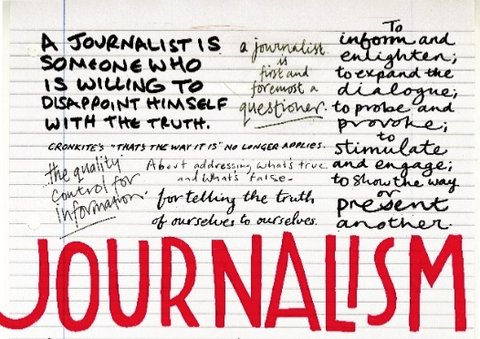
As soon as I finished reading Jay Rosen’s, “The Twisted Psychology of Bloggers vs. Journalists: My Talk at South by Southwest,” I immediately began to think of only one thing. I couldn’t get it out of my mind. It played over and over like a song on repeat.
Bloggers are Journalists, Journalists are Bloggers.
Bloggers are Journalists, Journalists are Bloggers.
Say it with me, just one time. You’ll instantly feel better.
Bloggers are Journalists, Journalists are Bloggers.
Now that we have gotten that out of the way, I will discuss the finer points in Rosen’s talk on this neverending barrage of insults exchanged between bloggers and journalists, and the potential reasons for it.
He begins by reiterating that the “distinction is eroding” and “the war is absurd” and that everyone should just get over it – points Rosen made in 2005 in his essay “Bloggers vs. Journalists is Over.” I happen to agree with these statements. However, I do realize that it is easier said than done because there are some existing finite distinctions which are still applicable.
 Then, he makes an excellent point by stating that “bloggers and journalists are each other’s ideal ‘other.'” If you aren’t quite sure what he means by this, let me enlighten you:
Journalists are:
- trained
- reputable in the eyes of many
- paid (although not always well)
- allowed certain advantages by wielding their “easy to get” press pass and employer name dropping
- given certain leeways in some situations.
Bloggers are:
- mostly untrained (or at least traditionally – that is one of the areas changing in this new frontier)
- often not considered as reputable as a “real journalist”
- have a harder time getting a press pass to large public events
- not given leeways in as many situations, such as with shield laws.
Now, on the other hand:
Journalists:
- spend years going to a traditional (or even untraditional) J-school
- are usually employed by some version of “the man”
- underpaid and overworked (especially in today’s industry)
- must remain “in the open” and are held accountable for their work, if by nothing else, their byline
- worked for years or decades as an underling in order to earn their “column inches”
- must abide by certain rules of the trade such as keeping their political views quiet or not cheering in the press box at the big game
- must cover stories they find uninteresting
- have work hours regulated, by not only the story but by their editor and editor’s editor
- spend hours looking for an original story and then they must spend more time researching, getting interviews, and editing and re-editing
- held to high standard in regards to original content and wording
- have to answer to a “higher being” (and no, I don’t mean God or Buddha or whomever). By working for a reputable for profit company they must answer to their boss but also, their boss must answer to his boss, and on up the chain. Then, it is more likely that a company will have to answer officially to the US Government if they publish information “not liked.”
Bloggers:
- do not have to get training, attend school, or earn a degree in journalism (but some do)
- are usually self-employed or blog in their leisure time (sometimes this is a considerable amount of time but still it is their time)
- mostly unpaid
- can choose to remain anonymous (although many don’t)
- didn’t have to “earn” their place before receiving “column inches”
- do NOT have abide by any rules of the trade such as keeping their political views quiet or not cheering in the press box at the big game
- can choose to only cover stories they find interesting
- work hours are unregulated in general
- can choose to aggregate stories from other “sources” and mediums or to simply “re-post” a story on their blog or on various social media although some do spend hours writing original stories but do NOT have to answer to an editor before publishing
- not held to the same standards in regards to plagiarism
- do not have to answer to anyone and the US Government seems to pay them less attention
Each, has their own pros and cons that the other covets. The Journalist is envy of the immediate publishing rights of the blogger and the lack of training. The Blogger is envious of the respect received by the Journalist, and so on and so forth.
Journalists chose to say things disparaging bloggers, such as in an Editor’s Column in an Australian newspaper did when he said: “Bloggers…represent nothing. They whinge, carp, and whine about our role in society, and yet they contribute nothing to it, other than satisfying their juvenile egos.”
Who’s being the child now, mister Editor? Say what you mean – you’re jealous of some of the advantages that bloggers receive and some of the respect that they are receiving as well.
 Bloggers choose to talk about the “lamestream media” but many of them re-post stories from these same outlets. Bloggers, say what you mean – you’re upset at how they chose to write the article, you think they are playing lapdog to the government, and you’re also jealous at the recognition they receive for doing it.
If everyone would just say what they mean – then they all have valid points. It’s when the blame game starts and the finger pointing turns to mud-slinging that society is losing. Both mediums and both “professions” are valid and needed in our society.
It has come to the point where some journalists aren’t being objective (neither are the bloggers, but they aren’t typically supposed to and the ones that choose to, bully for them), aren’t acting as the watchdog for the government, have sold out or are refusing to open their eyes and study a situation from all angles. So now, the bloggers are the watchdog of the journalists. The journalists, with as much weight as their words carry and as far as their pens reach, should be held accountable by the people. Bloggers are there to do that.
Don’t get me wrong – not all bloggers are worth the laptops they write on. Their bogs are filled with grammatically incorrect, uninsightful, regurgitated, or ignorant garbage. But as I said earlier in this post, when talking about Shirky’s theory of mass amateurization and thus, forced filtering – we must filter the good from the bad! Don’t throw the baby out with the bathwater! Some journalists aren’t worth their press badges, either. So let’s all stop pointing fingers and mud-slinging and get back to the issue at hand.
 Blogging is not going to REPLACE the press! Rosen said it differently by saying “blogging cannot replace the watchdog journalism that keeps a government accountable to its people,” but I don’t exactly agree with that statement – at this time. I feel that all of the press isn’t doing the best job in that department these days. A majority is blatantly ignoring candidates running for office and singing praises of government officials when no praise should be sung – among other things. However, I believe that true journalism will last and it should last. It should live on to overcome the disruption caused by the internet, social media, and blogging to its livelihood and perform the duties it was created to perform.
Journalists ARE trained and may know a few things bloggers don’t. Lucky for me, I’m both a trained journalist and a blogger. I choose to work as a blogger with the values and knowledge, of a journalist.
Rosen stated that “bloggers look more like the ancestors of today’s journalists,” and in many ways, I agree. Thomas Jefferson was a huge proponent of the free press as hopefully, most of you know. In his time, the newspapers were filled with biased viewpoints and writers, reporters, editors, and journalists who felt the need to answer to a “higher being” – usually the person, who paid the person, who paid the writer.
His idea of the First Amendment in  our Bill of Rights, which keeps the government from taking away our inherent right to free speech and press, was one of complete and total freedom. He felt that no longer should citizens remain quiet when they saw injustice. He urged them to pick up the pen and publish their thoughts – and that, they did. Today’s bloggers feel the need to pick up their pen and publish their thoughts just as our forefathers did. The profession of Journalism remained intact then, although changed by the pressures of the people. So as Journalists today, instead of playing the blame game and complaining about what bloggers are doing or the respect that they are receiving, ask yourselves this – Why do they feel so compelled to write and speak out? Why are they receiving respect for what they do? How could you learn from them or from what they are saying? How could you be better?
I leave you with a few words of wisdom from Thomas Jefferson:
“Our liberty depends on the freedom of the press, and that cannot be limited without being lost.”
“Nothing can now be believed which is seen in a newspaper. Truth itself becomes suspicious by being put into that polluted vehicle.”
“Whenever the people are well informed, they can be trusted with their own government; that whenever things get so far wrong as to attract their notice, they may be relied on to set them to rights.”
“The basis of our governments being the opinion of the people, the very first object should be to keep that right; and were it left to me to decide whether we should have a government without newspapers or newspapers without a government, I should not hesitate a moment to prefer the latter. But I should mean that every man should receive those papers and be capable of reading them.”
“Where the press is free, and every man able to read, all is safe”
“Our first object should therefore be, to leave open to him all the avenues of truth. The most effectual hitherto found, is freedom of the press. It is therefore, the first shut up by those who fear the investigation of their actions”

The 2014 Tweeting Tigers’ Twitter Hunt
LinkPhoto365 Challenge – Day 22
ImageBonono was not happy that I was giving attention to Bones that evening.
He resorted to ninja monkey tactics!

Check back in everyday during this Photo365 Challenge to see more antics from Bonono (and Bones)!
Dont forget – Bones is currently working on his own Photo365 Challenge. If you’re interested in seeing what he is up to, follow him by clicking here.
Photo365 Challenge – Day 21
StandardFAMILY PICTURE TIME!
Bonono and Bones were having a great time in Nashville, at the Tennessee Press Association Winter Conference. Barry and I were excited to get out of town as well.


 The World According to Robin